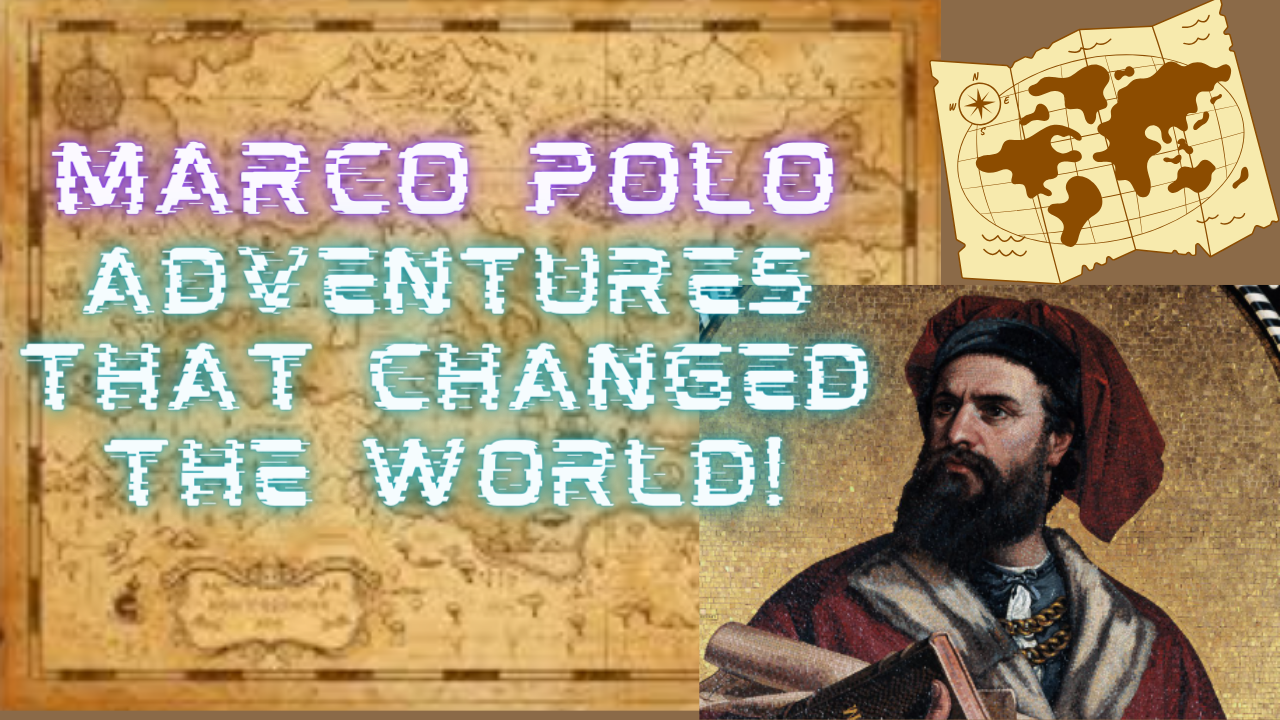
In the annals of history, few names evoke the spirit of adventure and discovery as vividly as Marco Polo. Born in the heart of Venice in 1254, Marco Polo’s life was an odyssey that spanned continents, cultures, and centuries. His extraordinary journeys to the farthest reaches of the known world transformed him from a mere merchant
to an immortal legend whose stories would inspire generations of explorers, writers, and dreamers.
The Venetian Origins
Marco Polo was born into a wealthy Venetian merchant family. His father, Niccolò, and his uncle, Maffeo, were successful traders who had already ventured far beyond the familiar confines of Europe. It was this adventurous spirit that Marco would inherit, setting the stage for his own incredible voyages.
Setting Sail for the East
At the tender age of 17, Marco Polo embarked on a journey that would change the course of his life—and the world’s understanding of it. Accompanying his father and uncle, he traveled overland from Venice to the court of Kublai Khan, the Mongol emperor, in what is now China. This monumental journey, covering some 15,000 miles, took over three years and was fraught with peril, from treacherous deserts to towering mountain ranges.
Life at the Court of Kublai Khan
Upon reaching the court of Kublai Khan, Marco Polo found himself in a world unlike any he had known. The Mongol Empire was a vast and sophisticated realm, with advanced technologies, bustling cities, and a diverse population. Marco quickly became a favorite of the Khan, who was fascinated by the young Venetian’s tales of the West.
Kublai Khan appointed Marco to various diplomatic and administrative roles, sending him on missions across the empire. This unique position allowed Marco unprecedented access to the inner workings of the Mongol court and the lands it controlled. His keen observations and detailed descriptions of everything from the splendor of the Khan’s palace to the intricacies of Chinese paper money provide an invaluable snapshot of 13th-century Asia.
The Return Journey and Writing the “Il Milione”
After nearly two decades in the service of the Khan, the Polos finally returned to Venice in 1295, laden with riches and stories beyond belief. Yet, it wasn’t until Marco found himself imprisoned during a naval conflict between Venice and Genoa that his tales began to take on a life of their own. While in prison, he dictated his adventures to a fellow inmate, Rustichello da Pisa, who penned what would become known as “The Travels of Marco Polo” or “Il Milione.”
This book was an instant sensation, captivating audiences with its vivid descriptions of far-off lands, exotic customs, and extraordinary experiences. Skeptics doubted the veracity of Marco’s accounts, but whether entirely factual or embellished, “Il Milione” opened the eyes of Europe to the wonders of the East.
Historical Significance
Marco Polo’s travels had profound and lasting impacts. His accounts introduced Europeans to the wealth and sophistication of Asian civilizations, spurring interest in trade and exploration. The Silk Road, a network of trade routes connecting the East and West, became even more vital, fostering cultural and economic exchanges that shaped the course of history.
Moreover, Marco Polo’s tales would later inspire other great explorers, most notably Christopher Columbus. Columbus carried a copy of “Il Milione” on his voyages, hoping to find the same riches and wonders described by Marco Polo.
Lifestyle and Legacy
Marco Polo lived in a time of great change and exploration. His lifestyle as a merchant and traveler was one of curiosity, adaptability, and resilience. He navigated diverse cultures, languages, and landscapes with an open mind and a keen eye for detail. This adaptability was key to his survival and success, allowing him to gain the trust and favor of powerful rulers like Kublai Khan.
The legacy of Marco Polo extends beyond his lifetime. His journeys are a testament to the power of curiosity and the human spirit’s insatiable desire to explore the unknown. His detailed accounts provided one of the earliest comprehensive looks at the cultures, economies, and technologies of Asia, influencing countless fields from geography to anthropology.
Conclusion: The Eternal Explorer
Marco Polo’s name is synonymous with adventure and discovery. His life story, brimming with extraordinary journeys and encounters, continues to captivate and inspire. From the bustling canals of Venice to the majestic court of Kublai Khan, Marco Polo’s travels bridged worlds and eras, leaving an indelible mark on history. As we marvel at his achievements, we are reminded of the endless possibilities that lie beyond the horizon, waiting to be discovered by the next generation of explorers.