For decades, scientists have asked: Does life exist beyond Earth? Mars has long been a prime candidate in this search. Thanks to the perseverance of NASA’s rovers and advanced instruments, we may be closer than ever to answering that question. In recent months (as of September 2025), fresh evidence has emerged from Mars that strongly suggests the Red Planet once hosted microbial life. This post delves into the latest findings, what they mean, and what still remains to be proven. (New Evidence Of Life On Mars)
What’s New: Key Discoveries
Here are the most recent and significant findings related to possible life on Mars:

- The “Sapphire Canyon” Sample & “Cheyava Falls” Rock
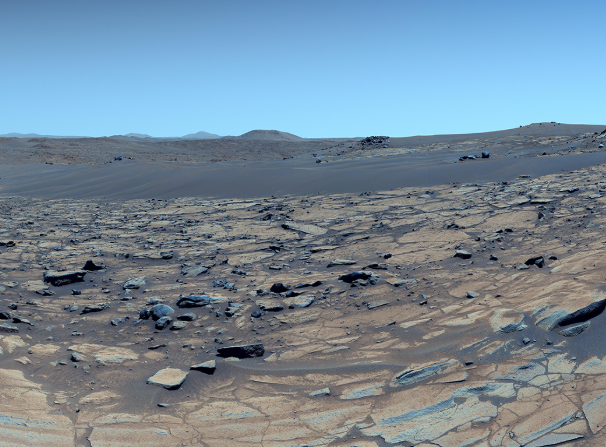
- NASA’s Perseverance rover, in July 2024, collected a sample dubbed Sapphire Canyon from a rock nicknamed Cheyava Falls, located in the Bright Angel formation in Jezero Crater. NASA+2PBS+2
- Inside this mudstone rock (formed 3.2-3.8 billion years ago from lakebed sediment), scientists found ring-shaped dark features, “leopard spots,” and minerals usually associated with microbial activity on Earth—namely vivianite and greigite. Wikipedia+3Reuters+3mint+3
- These features also include organic carbon and chemical reaction fronts enriched in iron, phosphate, and sulfur—elements involved in biological processes on our planet. Space+2NASA+2
- Largest Organic Molecules Found by Curiosity
- In earlier 2025, the Curiosity rover uncovered long-chain alkanes (up to 12 carbon atoms) in a rock from Yellowknife Bay, dating back to ~3.7 billion years. These molecules are akin to breakdown products of fatty acids, which are key components of cell membranes in living organisms on Earth. Live Science+1
- While alkanes can also form by non-biological (abiotic) chemical processes, their presence in such old, lakebed-derived rocks raises the possibility that traces of ancient life might have been preserved. Live Science+1
- Signs of Ancient Water and Habitable Conditions
- The presence of the Bright Angel formation and the Cheyava Falls sample’s geological context points to ancient river valleys (Neretva Vallis) and lakebeds, making them likely to have held water. These are favorable places for microbial life. NASA+2Space+2
- Also, evidence from other missions (e.g. Chinese rover Zhurong) show preserved sandy beach-like structures under Mars’ surface, suggesting long-lasting wave action and, by extension, sustained bodies of water in Mars’ past. Reuters
- Planetary Structure & Geological Context
- Understanding the internal structure of Mars — such as the presence of a solid inner core revealed recently — helps scientists reconstruct Mars’ thermal history, which is crucial for knowing when and where life might have been possible. The Times of India

What These Discoveries Mean (New Evidence Of Life On Mars)
Putting together all these findings gives us a clearer picture:
- Strongest Evidence Yet for Ancient Microbial Life
The discovery of biosignature candidates in rocks like Cheyava Falls is being called perhaps the most compelling evidence so far that Mars may once have had microbe-friendly environments. That doesn’t mean life is confirmed, but it brings us significantly closer. The Washington Post+2Smithsonian Magazine+2 - Habitability vs. Biology
There’s a difference between an environment being habitable (having water, the right chemical elements, moderate conditions) and actual biological activity. Many of these findings confirm habitability in Mars’ distant past. The actual evidence of biology must satisfy stricter criteria. PBS+2Space+2 - Need for Sample Return & Earth Labs
Instruments on rovers are powerful, but many tests (especially for definitively ruling out non-biological origins) are only possible with more extensive lab equipment on Earth. The Mars Sample Return mission remains critical to confirm these findings. Reuters+2Space+2 - Cautions Still Remain
Scientists emphasize caution. Minerals like vivianite or greigite can sometimes form without life, due to purely chemical/geological processes. Heat, pressure, volcanic activity or metal-rich environments could mimic some biosignatures. Also, the preservation of organic materials over billions of years is tricky. NASA+1

Why This Matters (New Evidence Of Life On Mars)
- Scientific Implication: If life ever began on Mars, even in microbial form, it greatly increases the likelihood that life (or its remnants) could exist elsewhere in the universe.
- Planetary Evolution: These findings help us chart Mars’ transition from a more watery, warmer planet to the cold dry world it is today, and understand what drove those changes.
- Human Exploration: For future missions (especially involving humans), knowing whether Mars had life, where water was, and which regions are most promising is essential for planning.
- Tech & Research Direction: Calls for funding, support for sample return, and development of new detection tools are likely to intensify.

What’s Next: What We Still Want To Know
To move from evidence to proof, here’s what scientists are focusing on:
- Returning samples from Mars to Earth for advanced analysis (e.g., Mars Sample Return mission).
- More detailed study of organic molecules: their abundance, complexity, distribution, and whether they are indigenous or contaminants.
- Better discrimination between biological vs. abiotic processes that could produce similar mineral/chemical signatures.
- More geological mapping to discover other promising locations with past water, for example ancient lakebeds, river channels, and beaches.
- Long-term monitoring of Mars’ subsurface water, brines, and environmental conditions.
Conclusion (New Evidence Of Life On Mars)
The recent discoveries by NASA’s Perseverance and Curiosity rovers are edging humanity closer than ever to answering: Was there ever life on Mars? With findings like biosignature candidates in ancient mudstone, long-chain organic compounds, and solid geological evidence of watery environments, the pieces are coming together—but the picture isn’t complete yet. A cautious optimism is warranted: we are seeing some of the most convincing signs of ancient life on Mars, but the final confirmation still lies ahead.
Stay tuned as more results come in, particularly once Mars samples are returned, and as scientists continue to test, refine, and (hopefully) confirm these tantalizing clues.

SEO & Keywords to Use (New Evidence Of Life On Mars)
- Life on Mars
- Evidence of ancient life on Mars
- Mars biosignature discovery
- Perseverance rover findings
- Organic molecules on Mars
- Jezero Crater Mars
- Mars sample return mission

Similar Blogs: