

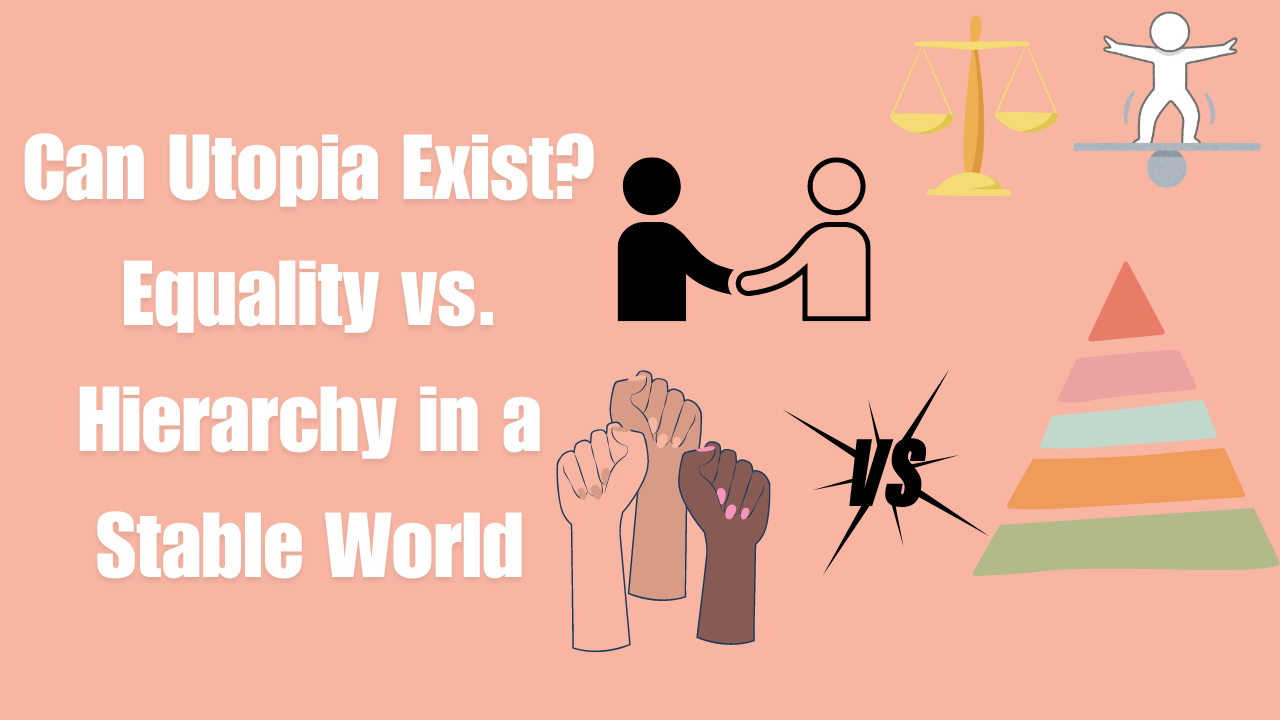
Imagine a world without social class, where everyone has equal opportunities and resources. Sounds idyllic, right? But is a perfectly equal society, a utopia, actually achievable? Let’s explore the potential benefits and the inherent challenges of such a world, and consider whether true equality can coexist with a stable social order.
The Dream of Perfect Equality:
- Fairness and Justice: A world without social hierarchies would represent the ultimate embodiment of fairness. Everyone would have equal access to education, healthcare, and opportunities for advancement.
- Social Harmony: Without the resentment and social friction caused by vast inequalities, a more peaceful and harmonious society could emerge.
- Unleashing Potential: If social status wasn’t a barrier, everyone could pursue their passions and contribute their talents to society, leading to greater innovation and progress.
The Challenges of Absolute Equality:
- Motivation and Incentives: Would people be as motivated to work hard and achieve if everyone received the same rewards, regardless of effort or contribution?
- Leadership and Expertise: Complex societies require leadership and specialized skills. In an entirely equal system, who would take on these roles and how would they be chosen?
- Human Nature and Diversity: People are naturally diverse in abilities, interests, and motivations. Wouldn’t a completely equal society stifle these natural differences and hinder progress?
The Laws of Nature and Hierarchy:
- Competition and Cooperation: Nature itself is a balance between competition and cooperation. Hierarchies exist throughout the animal kingdom, with leaders and followers working together for survival.
- Specialization and Efficiency: Societies function because people specialize in different roles. Doctors, teachers, and engineers wouldn’t exist if everyone pursued the same status and rewards.
Finding the Balance:
Perhaps a truly equal society, where everyone is identical, is unrealistic and undesirable. However, a world that strives for equality of opportunity, with social mobility and fair access to resources, could be a more stable and just place.
Here are some possibilities for achieving a more balanced world:
- Meritocratic Systems: Rewarding effort and contribution can incentivize hard work while promoting a sense of fairness.
- Social Safety Nets: Ensuring basic needs are met for everyone provides a level playing field and reduces inequality.
- Education and Opportunity: Investing in education allows individuals to develop their talents and compete fairly for advancement.
Conclusion:
While a perfectly equal utopia might be a fantasy, working towards a more equitable world has real benefits. By acknowledging the complexities of human nature and the need for some level of specialization, we can strive for a society that fosters both stability and opportunity for all.
What do you think? Can true equality and social stability coexist? What are your ideas for creating a fairer and more just world? Share your thoughts in the comments below!


Thanks for sharing. I read many of your blog posts, cool, your blog is very good. https://accounts.binance.info/register/person?ref=IXBIAFVY
Thank you for your sharing. I am worried that I lack creative ideas. It is your article that makes me full of hope. Thank you. But, I have a question, can you help me? https://accounts.binance.info/fr-AF/register/person?ref=JHQQKNKN