

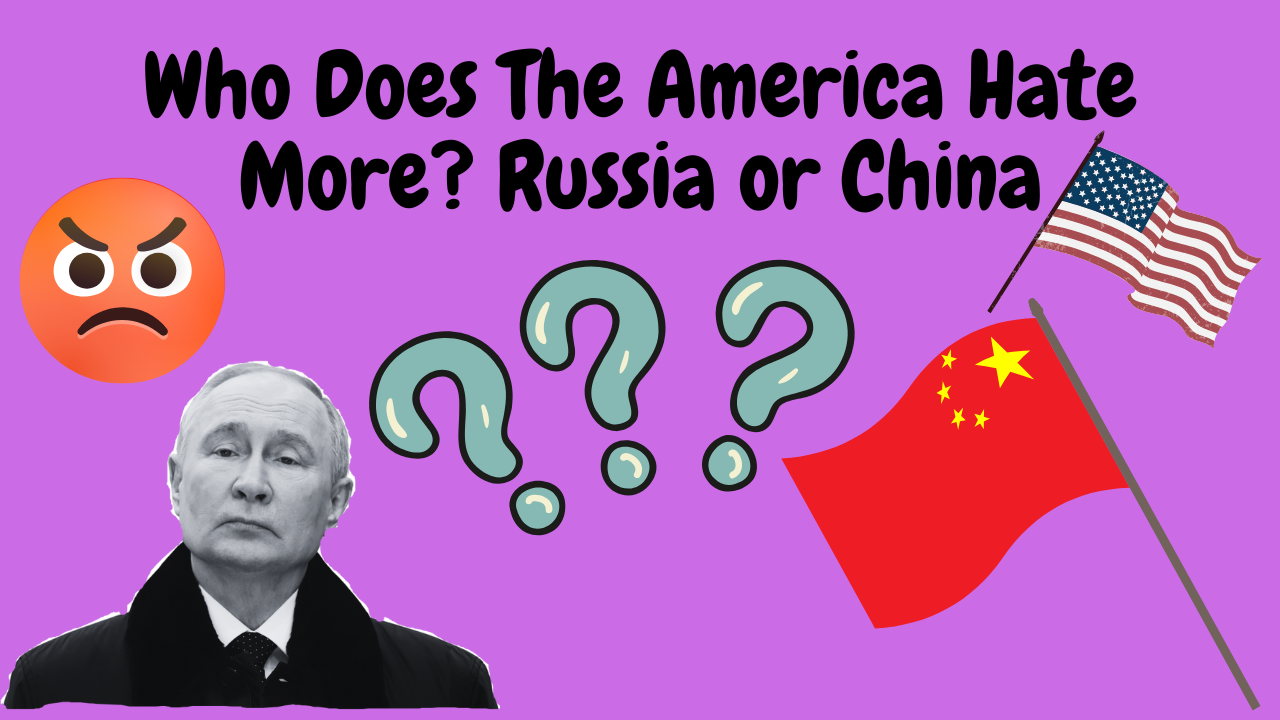
When discussing U.S. foreign relations, the rhetoric surrounding adversarial nations often brings two countries into focus: Russia and China. Both nations represent significant geopolitical rivals to the United States, but the degree and nature of American disdain for each differ, shaped by historical events, economic competition, and contemporary global issues. (Who Does The America Hate)
A History of Tensions
Russia: The animosity toward Russia has deep Cold War roots. Following World War II, the ideological battle between the U.S. and the Soviet Union dominated global politics. The arms race, proxy wars, and the threat of nuclear annihilation created a legacy of mistrust. Even after the dissolution of the Soviet Union in 1991, relations remained strained due to Russia’s actions in Ukraine, alleged interference in U.S. elections, and its autocratic domestic policies under Vladimir Putin.
China: U.S.-China relations, on the other hand, have oscillated between cooperation and competition. While the Nixon-era opening of China in the 1970s marked a significant thaw, economic tensions have grown over the decades. Accusations of intellectual property theft, trade imbalances, and China’s rise as a technological and military power have fueled American concerns. Additionally, China’s actions in the South China Sea, its treatment of Uyghur Muslims, and the suppression of democracy in Hong Kong have further eroded trust.
Economic Rivalry
China poses a unique challenge as the world’s second-largest economy and America’s largest trading partner. The U.S. perceives China’s rapid technological advancements—in AI, 5G, and green energy—as a direct threat to its global dominance. Meanwhile, China’s Belt and Road Initiative (BRI) expands its influence across Asia, Africa, and Europe, challenging the U.S.-led global order.
Russia’s economy, while significant, is far smaller and more resource-dependent. Its geopolitical maneuvers—such as leveraging energy supplies in Europe—are more regional than global. Thus, while Russia garners attention for its military actions and cyber capabilities, it lacks the economic heft to rival China.
Ideological Conflicts
Both Russia and China stand as counterpoints to American democratic ideals. Russia’s centralized control under Putin and China’s authoritarian Communist Party governance contrast starkly with the U.S.’s promotion of liberal democracy. However, China’s model of authoritarian capitalism—combining economic growth with strict political control—is seen as a more direct ideological competitor, especially in developing nations seeking economic progress without political liberalization.
Public Perception (Who Does The America Hate)
Public opinion polls in the U.S. reveal fluctuating levels of concern about Russia and China. For many Americans, Russia’s actions feel immediate and personal—such as election interference and aggressive military posturing. China’s challenge, while profound, is often perceived as a longer-term issue involving economic competition and global influence rather than direct confrontation.
Military Considerations (Who Does The America Hate)
Russia’s military interventions in Ukraine, Syria, and other regions highlight its willingness to use force to achieve geopolitical aims. Its nuclear arsenal and advancements in cyber warfare also make it a formidable foe. Meanwhile, China’s military focus has been on expanding its regional influence, particularly in the Indo-Pacific. The U.S. has ramped up alliances like AUKUS and Quad to counter China’s growing assertiveness.
The Verdict (Who Does The America Hate)
So, which country does America “hate” most? It depends on the context:
- If measured by immediate threats and provocative actions, Russia often takes the spotlight. Its direct interference in democratic processes and aggressive foreign policy stoke widespread anger.
- If assessed through the lens of long-term strategic rivalry, China emerges as the primary concern. Its potential to surpass the U.S. economically and technologically poses an existential challenge to American dominance.
In truth, America’s “hate” is a reflection of its strategic priorities. Both nations are viewed as adversaries, but the intensity and focus of animosity shift depending on the issue at hand. Whether it’s Russia’s military provocations or China’s economic rise, both continue to shape America’s foreign policy and its vision for the future.
Similar Blogs:



Creative wisdom! AI Kiss teaches us that AI is the ultimate creative tool.
Can you be more specific about the content of your article? After reading it, I still have some doubts. Hope you can help me. https://accounts.binance.info/cs/register/person?ref=OMM3XK51